SEC Transfer Agent Overhaul Would Write Blockchain Into the Rulebook
The U.S. Securities and Exchange Commission on Tuesday proposed the first substantive overhaul of its rules for registered transfer agents since the late 1970s and early 1980s, a package that would accommodate blockchain-based recordkeeping, impose new risk-management and compliance requirements, and rescind a 1977 exemption covering limited partnership interests and fund shares.
Transfer agents handle the issuance, cancellation, and transfer of paper and electronic securities and maintain the official record of who owns an issuer’s stock – functions the SEC called a key component of the national clearance and settlement system. The agency said its existing rules no longer adequately address the broader range of functions transfer agents now perform, including electronic communications and blockchain technology used in securities offerings and share transfers.
“This proposal would streamline and modernize the commission’s rules to reflect transfer agents’ current processes and operations, including the use of electronic communications and blockchain technology in connection with securities offerings and the transfer of shares,” said SEC Chair Paul S. Atkins. Jamie Selway, director of the SEC’s Division of Trading and Markets, said the proposal is “another important step in Chairman Atkins’ efforts to advance our regulatory framework for the modern era.”
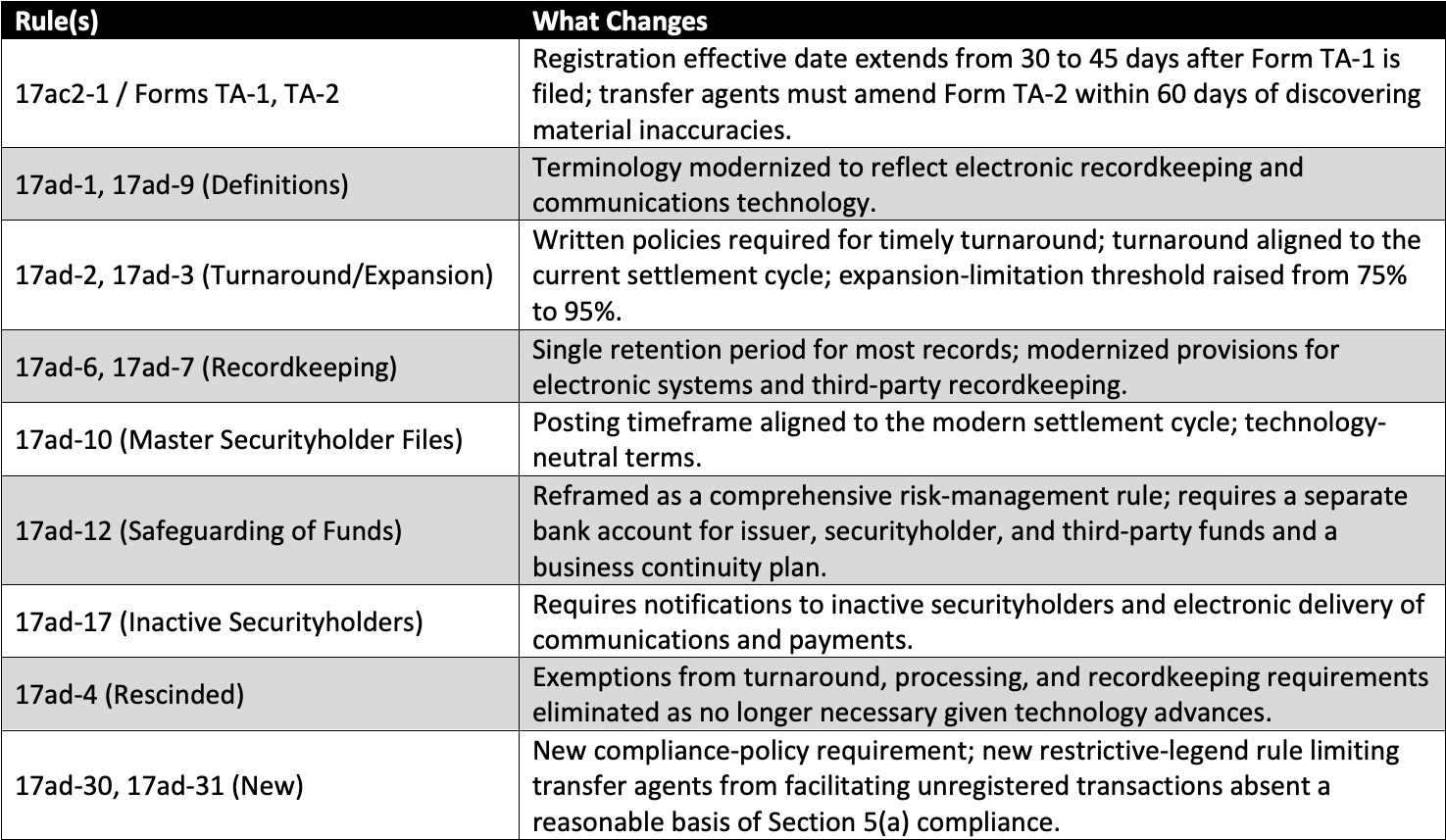
The proposal touches nearly every major transfer agent rule. It would extend the effective date of transfer agent registration from 30 to 45 days after a Form TA-1 is filed, require amended Form TA-2 filings within 60 days of discovering material inaccuracies, and update the questions and instructions on both forms. It would also rescind Rule 17ad-4, which exempts certain securities and transfer agents from turnaround, processing, and recordkeeping requirements – exemptions the SEC said are no longer necessary given technological advances across transfer agents of all sizes. A full breakdown of the proposed rule changes:
The rescission of Rule 17ad-4 would reach directly into the alternative investment fund servicing industry. That rule, adopted in 1977, currently exempts transfer agents from minimum turnaround, processing, and recordkeeping standards specifically when handling limited partnership interests, dividend reinvestment plan shares, and “fund shares” – the redeemable securities issued by open-end funds registered under Section 8 of the Investment Company Act of 1940. It also exempts smaller “exempt transfer agents” that handle fewer than 500 items every six months. The SEC said the exemptions are no longer justified given how far automation has spread, but the proposal itself asks whether rescission could push small transfer agents, or those specializing in limited partnerships and fund shares, to exit the market or consolidate with larger providers – a live question for a fund servicing niche that includes many nontraded and semi-liquid vehicles structured as LPs or open-end funds.
Two new rules would round out the package. Proposed Rule 17ad-30 would require transfer agents to adopt written compliance policies and procedures. Proposed Rule 17ad-31 reaches further into the restricted-securities market: it would require transfer agents to maintain a current list of issuer employees authorized to instruct legend removals, and would bar transfer agents from facilitating an unregistered securities transaction – including removing a restrictive legend or lifting a stop order – without a reasonable basis to believe the transaction doesn’t violate Section 5(a) of the Securities Act of 1933. Transfer agents could satisfy that standard either with an independent opinion of counsel or by documenting their own exemption analysis, subject to management review, and the proposal lists specific “red flags,” such as a sudden spike in investor demand for a thinly traded security or an issuer with several recent name changes, that should trigger further inquiry. Because transfer agents are frequently the gatekeepers that clear restricted shares for resale, the rule would add a documented compliance step to exactly the kind of secondary-market and legend-removal activity that underlies trading in nontraded real estate investment trust and business development company shares.
Under its Paperwork Reduction Act analysis, the agency pegged the proposal’s aggregate initial compliance cost across the roughly 327 currently registered transfer agents, plus 15 anticipated new registrants, at approximately $23.3 million. The largest drivers are the recordkeeping overhaul under Rules 17ad-6 and 17ad-7, estimated at $12.6 million, and new unresponsive-payee notification procedures under Rule 17ad-17, estimated at $5.1 million, with the new compliance-policy rule, 17ad-30, adding a further $2.4 million and updated turnaround standards under Rule 17ad-2 another $2.8 million. Ongoing annual costs after the initial buildout are comparatively modest, the agency’s estimates show.
The proposing release will be published in the Federal Register, and the public comment period will remain open for 60 days after publication.
The proposal lands directly on infrastructure the nontraded fund sector has been building out. In June, SEI launched a newly SEC-registered transfer agency built specifically to serve interval funds, tender-offer funds, business development companies, and other semi-liquid alternative vehicles – a category that topped $530 billion in net assets by the end of 2025, according to Morningstar data cited at the time. Because nontraded REITs, BDCs, and interval funds have no exchange listing, their transfer agents effectively serve as the sole system of record for who owns what, making rules like the proposed risk-management and recordkeeping standards more consequential for this sector than for exchange-listed issuers.
The proposal also fits a pattern. Atkins has made modernizing the SEC’s rulebook a centerpiece of his tenure, part of what he calls his ACT – Advance, Clarify, Transform – agenda. In April, he said the agency was preparing an “innovation exemption” for tokenized securities trading on blockchain networks, and in June, he detailed offering-reform and filer-status proposals aimed at nontraded REIT and BDC sponsors, alongside a broader retreat from what he described as regulation by enforcement. This transfer agent proposal, with its explicit references to blockchain-based recordkeeping and uncertificated securities, extends that same deregulatory and modernization push to the back-office infrastructure underpinning the sector.
Visit the AltsWire directory page.