
SEC Faces Hard Questions by Supreme Court Justices Over Disgorgement Without Investor Distributions
By Damon Elder
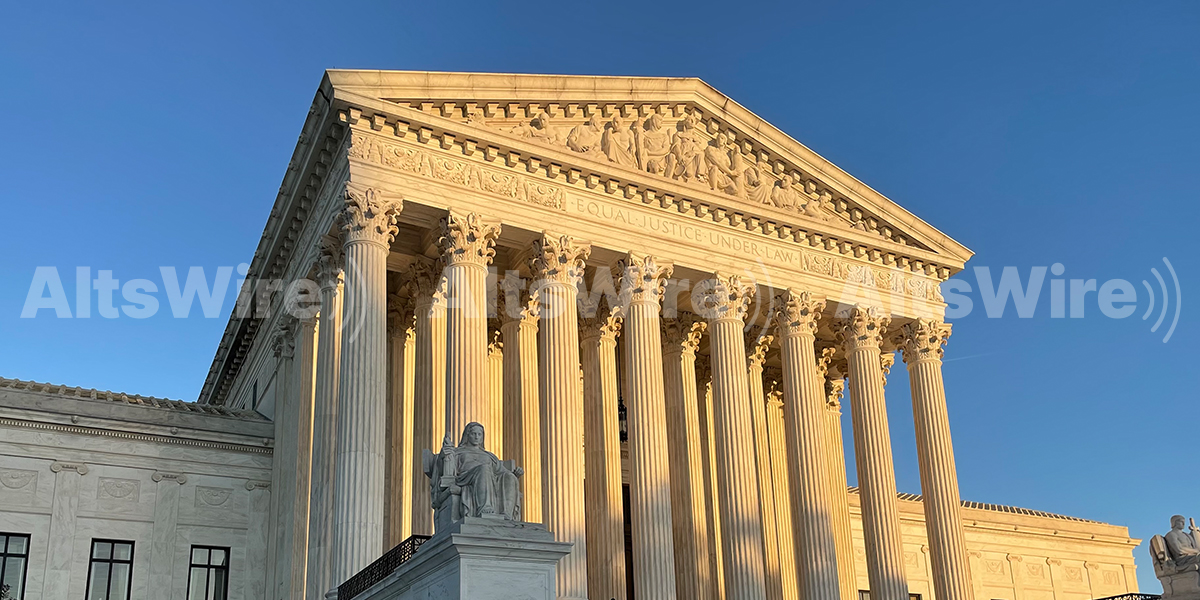
Justices across ideological lines questioned whether the U.S. Securities and Exchange Commission’s practice of collecting disgorgement without distributing proceeds to investors crosses into punishment – a distinction with significant implications for securities enforcement.
The U.S. Supreme Court heard oral argument Monday in Sripetch v. Securities and Exchange Commission, a case that could impose new limits on the SEC’s ability to collect disgorgement – its most powerful financial remedy – with justices across ideological lines pressing the government on whether stripping a defendant of profits with no plan to compensate investors is equitable relief or a penalty by another name.
The question before the justices is whether the SEC must prove that investors suffered pecuniary harm before a court may order disgorgement. The case arose from an SEC civil enforcement action against Ongkaruck Sripetch, who pleaded guilty to federal crimes related to a series of fraudulent penny stock schemes involving roughly 20 microcap companies.
In a separate civil proceeding, a federal district court ordered Sripetch to disgorge more than $2.2 million in profits – plus more than $1 million in prejudgment interest – without requiring the SEC to demonstrate that any investor had suffered pecuniary harm. The Ninth Circuit affirmed.
The outcome will resolve a split among the federal courts of appeals. The Second Circuit has emphasized limits on disgorgement tied to victim benefit and equitable principles. The First and Ninth circuits have held that no such showing is required, reasoning that disgorgement is tethered to a wrongdoer’s unlawful gain rather than a victim’s documented loss.
A Decade of Narrowing
Sripetch arrives as the third major Supreme Court challenge to SEC disgorgement authority in less than a decade – part of a sustained pattern in which the Court has repeatedly constrained the agency’s enforcement arsenal.
In Kokesh v. SEC (2017), the Court unanimously held that disgorgement is a “penalty” subject to a five-year statute of limitations, rejecting the SEC’s longstanding position that it was a remedial measure with no time bar. The decision opened the door to broader challenges by noting, in a heavily analyzed footnote, that the Court was expressing no opinion on whether courts even possessed authority to order disgorgement at all.
In SEC v. Liu (2020), written by Justice Sonia Sotomayor, the Court held that disgorgement must be limited to a defendant’s net profits and, critically, generally directed to the benefit of actual victims – not deposited in the U.S. Treasury as a generalized penalty. Congress subsequently amended the securities laws in an attempt to codify disgorgement authority in a new subsection, §78u(d)(7), but left key questions unresolved, including whether a showing of investor harm is required.
Then came SEC v. Jarkesy (2024), in which the Court held that when the agency seeks civil penalties for securities fraud, the Seventh Amendment entitles the defendant to a jury trial in an Article III federal court – ending the SEC’s ability to adjudicate fraud claims before its own in-house administrative law judges without a jury. The decision reinforced that the SEC’s enforcement remedies carry constitutional constraints that cannot be avoided by administrative procedure.
Sripetch extends that line. As petitioner’s counsel Daniel Geyser framed it to the Court, disgorgement untethered from investor compensation is not equity – it is punishment dressed in equitable language. “If the government thinks it’s hard to distribute funds, then they do have the option – seek civil penalties,” Geyser said. “But then you have to provide a jury trial.”
The Argument
The government’s position, presented by Deputy Solicitor General Malcolm Stewart, is that the plain meaning of “disgorgement,” i.e., the act of giving up ill-gotten gains, requires nothing more than proof that the defendant unjustly enriched himself through the violation. Stewart argued that Congress’s 2021 statutory amendments codifying disgorgement in §78u(d)(7) deliberately omitted Liu’s investor-benefit language, which had appeared only in the prior provision, §78u(d)(5). The new subsection, he argued, requires only that unjust enrichment be causally connected to the violation – with no further requirement that proceeds reach victims.
That position drew pointed resistance from multiple directions.
Justice Neil Gorsuch, who joined the Jarkesy majority and has been among the Court’s most skeptical voices on regulatory enforcement power, pressed Stewart directly on whether collecting disgorgement without routing it to investors – and retaining the proceeds in the Treasury – could survive the Seventh Amendment. “If you want the equitable remedy, you’ve got to behave,” Gorsuch said. “Without a jury trial right, all of equity, you’ve got to follow the rules of equity.” When Stewart maintained that the government could retain disgorgement proceeds without triggering a jury trial right, Gorsuch responded: “I think that’s pretty perilous, Mr. Stewart.”
Gorsuch also pressed Stewart on the gap between disgorgement ordered and amounts actually returned to investors. In fiscal year 2024, the SEC ordered more than $6 billion in disgorgement but returned $345 million to investors. In fiscal year 2025, it ordered approximately $10.8 billion and returned $262 million, according to statistics referenced during the argument. “What kind of efforts does the government make to get this money back?” Gorsuch asked. Stewart acknowledged he could not confirm what percentage of ordered disgorgement was actually collected, and said approximately 88 percent of collected amounts were “designated for distribution” in a given year – a qualification Gorsuch pressed him to clarify.
Chief Justice John Roberts noted that the government had not cited Jarkesy in its brief despite petitioner invoking it repeatedly. When Stewart argued that Jarkesy was irrelevant because it involved in-house administrative proceedings rather than federal court actions, Roberts suggested the structural question was not so easily distinguished: petitioner’s point, Roberts said, was that the government’s version of disgorgement “would treat the case as if it were a case like Jarkesy” in terms of how the remedy’s character should be assessed.
Justice Sotomayor, as the author of Liu, took issue with Geyser’s reading of her own opinion. She pushed back on his interpretation that Liu’s “fair compensation to the person wronged” language imposed a strict pecuniary harm requirement – pointing out that the relevant analysis in Liu was also grounded in the specific “for the benefit of investors” language of §78u(d)(5), which does not appear in the newer §78u(d)(7). But Sotomayor also confronted Stewart with a pointed structural challenge: if the government retains disgorgement proceeds rather than distributing them to investors, “that serves only one purpose – deterrence. And if it’s only deterrence, I think you have a much harder way to go to say that it’s not a Seventh Amendment violation to let the judge decide it.”
Justice Ketanji Brown Jackson, who appeared most sympathetic to the government, challenged Geyser’s characterization of victimless disgorgement as a penalty. “If we’re just disgorging his ill-gotten gains,” she said, “I guess I’m not sure I understand why that’s a punishment.” Jackson pressed Geyser repeatedly on the traditional equitable principle of unjust enrichment, which she argued independently justifies stripping defendants of gains without requiring a showing of victim loss. But even Jackson pressed Stewart on whether the government’s distribution practices are central to the analysis.
Justice Clarence Thomas, who opened the argument by questioning whether disgorgement remains equitable at all after the 2021 statutory codification – quipping that “as far as I was concerned, it was homeless to begin with” – pressed Stewart on whether it would be a cleaner argument to simply concede the remedy is legal in nature, which would trigger jury trial rights but resolve the equitable analysis.
Justice Amy Coney Barrett pressed both parties evenhandedly and did not signal a clear lean.
Where It Stands
A ruling is expected by the end of the Court’s term in late June or early July. Based on questioning from multiple justices, the government faces a potentially difficult path, though the Court may not deliver the broad ruling petitioner seeks. The most significant dynamic across the argument was cross-ideological concern about the government’s concession that it can retain disgorgement proceeds without routing them to investors. That concession drew skepticism from both Gorsuch and Sotomayor – ideologically distant justices who found common ground in questioning whether disgorgement without investor compensation is, in substance, a penalty.
A likely outcome, based on the argument, is a decision that addresses the circuit split on pecuniary harm while leaving the Seventh Amendment implications for another day – an approach Gorsuch explicitly raised and Stewart acknowledged was available to the Court. Whether the Court resolves the pecuniary harm question in the government’s favor, the petitioner’s favor, or on some middle ground that requires distribution to investors even absent proof of pecuniary harm, remains genuinely uncertain.
For broker-dealers, registered investment advisers, and the distribution professionals who serve the alternative investment industry, the practical stakes are direct. Disgorgement was the larger component of SEC financial recoveries even in fiscal year 2025, a year in which the agency filed 22% fewer enforcement actions and Chairman Paul Atkins declared a break from volume-based enforcement in favor of cases involving direct investor harm.
A ruling constraining disgorgement to cases of demonstrated investor harm would narrow the agency’s leverage in settlement negotiations and complicate its ability to seek large financial penalties in matters – including supervision and suitability cases – where individual investor losses are difficult to quantify.
Visit the AltsWire directory page.