Private Placement REITs, BDCs Gain Market Share as NAV Hits $127.7B

Private placement real estate investment trusts and business development companies reached a combined aggregate net asset value of $127.7 billion as of Sept. 30, 2026, up 6.5% from the second quarter and 34.6% year-over-year, according to investment banking firm Robert A. Stanger & Co.
Both segments outraised their publicly registered nontraded counterparts through September. Private placement REITs accounted for 29.5% of the nontraded REIT market, up from 28.5% in the second quarter, while private placement BDCs represented 42.8% of the nontraded BDC market, up from 40.5% at June 30, as AltsWire reported in August. Private placement BDC aggregate NAV rose 6.3% in the quarter.
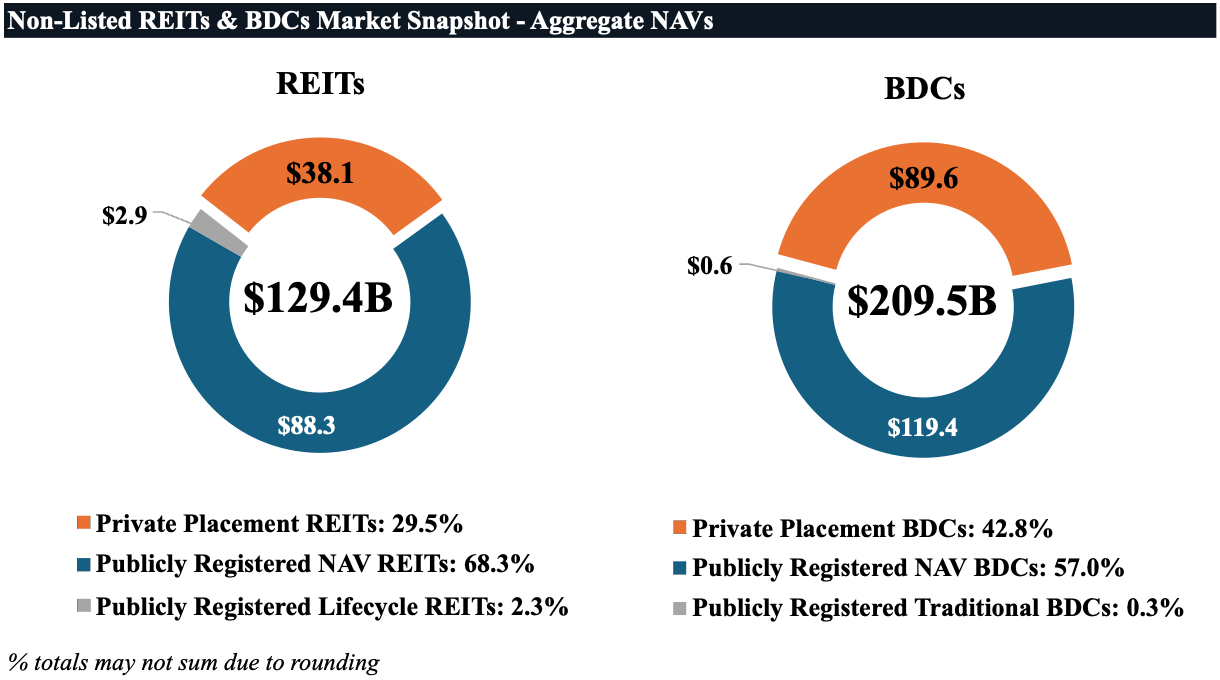
Graphs courtesy of Robert A. Stanger & Co.
Private Placement REITs
Private placement REITs raised $7.1 billion through September, up 16.9% from the same period of 2025 and 58.7% of combined nontraded REIT fundraising. Publicly registered nontraded REITs raised $5 billion over the same period, according to Stanger’s October data. Private placement REITs have outraised their publicly registered peers for eight consecutive quarters, Stanger said.
The Stanger Private NAV REIT Total Return Index gained 2.2% in Q3 and 9.6% over the trailing 12 months, while the three major listed REIT benchmarks Stanger tracks averaged a 6.2% decline in the quarter. Private placement REIT sponsors met 99.5% of redemption requests, returning $311 million to investors and leaving an estimated $2 million unmet, according to the firm.
New vehicles continue to come to market. American Residential Housing Trust, Angel Oak Residential Evergreen Trust, and Pretium Housing Income Trust registered with the SEC since the prior edition of the report. HPS Net Lease Income REIT completed its initial retail closing Nov. 16, releasing approximately $99 million in subscription proceeds from escrow to begin operations, Stanger said.
“In 2021, private placement REITs raised $752 million, a small fraction of non-listed REIT fundraising,” said Kevin T. Gannon, chairman and chief executive officer at Stanger. “Through September of this year, they raised $7.1 billion, nearly 60% of the total. This reflects a meaningful shift in how capital is being raised across the non-listed real estate market. As investors continue seeking hard asset exposure, private placement REITs are gaining scale, supported by positive performance, limited redemption pressure, and a growing pipeline of new offerings.”
Private Placement BDCs
Private placement BDCs raised $10.2 billion through September, down 27.4% year-over-year, while publicly registered nontraded BDC fundraising fell 76% to $8.6 billion. Private placement BDCs have outraised publicly registered BDCs in each of the past two quarters. Sagard Private Income Fund and Garry Oak Capital BDC registered with the SEC since the prior edition.
Redemption demand moderated in Q3. Across 30 private placement BDCs conducting regular repurchase offers, requests equaled 4.0% of NAV. Sponsors met 64% of requests, returning $902 million to investors. Publicly registered NAV BDCs received Q3 requests equal to 11.3% of NAV and met 41%, according to Stanger.
Among the 24 private placement BDCs that conducted regular offers in both Q2 and Q3, requests fell from 5.4% to 4.3% of NAV and estimated unmet demand declined 21%. Early Q4 results from seven funds show requests of 3.7% of NAV, compared with 4.5% in Q3, though Stanger said the sample remains limited. In April, AltsWire reported that 19 private placement BDCs reporting Q1 results had fulfilled 74% of redemption requests.
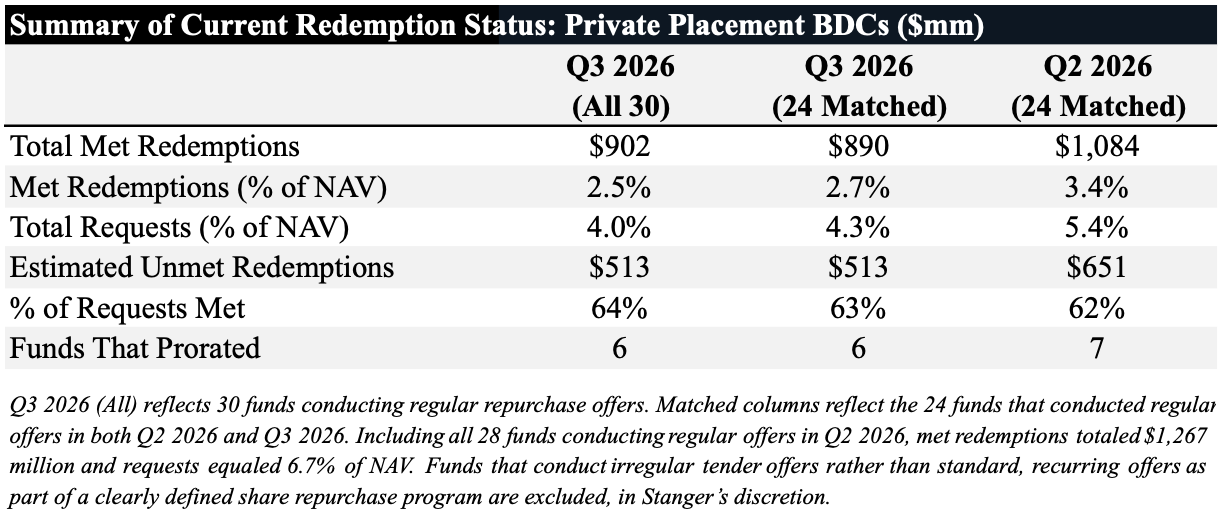
Chart courtesy of Robert A. Stanger & Co.
“Private placement BDCs are moving through the same liquidity cycle as the publicly registered market, but at a noticeably lower intensity,” said Michael S. Covello, executive managing director at Stanger. “Fundraising has held up better and net flows remain positive, while redemption requests have been lower as a percentage of NAV. Unmet demand has come down, though requests still exceed repurchase capacity at six funds. We’re also seeing the market begin to consolidate through mergers, fee reductions, and select wind-downs, which should leave a stronger set of vehicles as the cycle plays out.”
Visit the AltsWire directory page.