
From Boomers to Gen Z: How Advisers Can Capitalize on the $124T Wealth Transfer

By Joseph DaGrosa Jr., Chairman and CEO, Axxes Capital
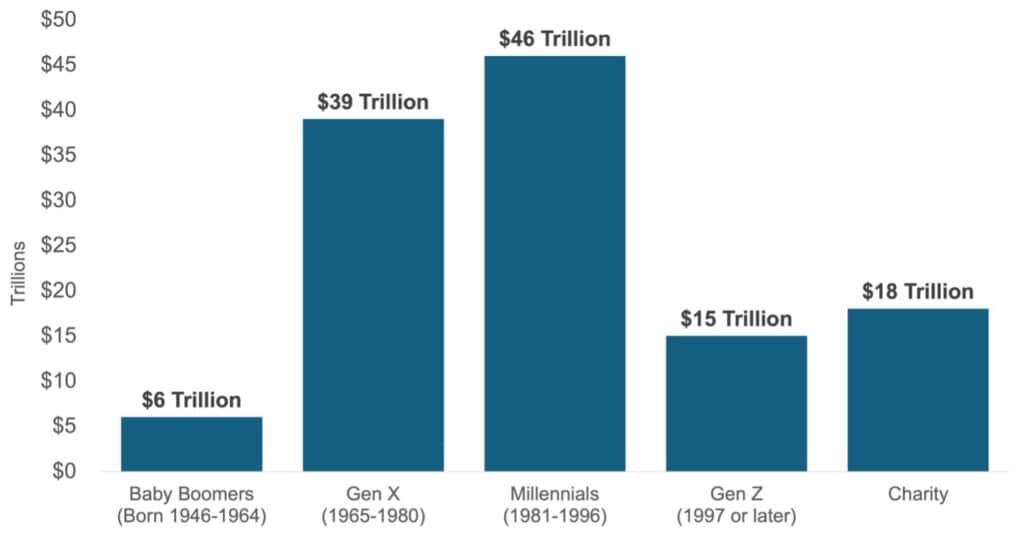
One of the most dramatic shifts in personal finance is currently underway: the “great wealth transfer.” According to Cerulli Associates, about $124 trillion in assets will transfer by 2048, with nearly $100 trillion, or 81%, coming from baby boomers or older generations. Gen X stands to inherit the most over the next 10 years, $14 trillion, while millennials are expected to inherit the most overall at approximately $46 trillion.
For perspective, a white paper from Cheetah noted this amount is greater than the combined GDP of the United States, the European Union, and China. The numbers involved may be staggering, but the implications are clear for advisers: the client profile is shifting fast, and so are the desired investment solutions.
Estimated Wealth Inheritances Through 2048 by Generation
Source: The Cerulli Report: U.S. High-Net-Worth and Ultra-High-Net-Worth Markets 2024. Cerulli Associates. Dec. 5, 2024.
The Future of Wealth May Be Private
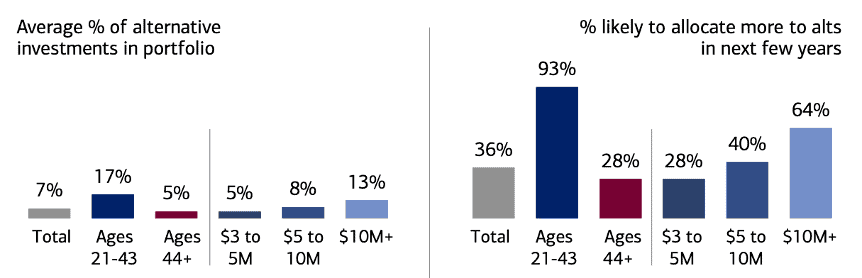
Younger generations, including Gen X, millennials and Gen Z, often have investing preferences remarkably different from previous generations. For example, according to a 2024 Bank of America survey, 72% of investors aged 21-43 stated that they believed it is no longer possible to achieve above-average returns solely with traditional stocks and bonds, versus just 28% for older investors.
Additionally, younger high-net-worth investors allocated 17% of their portfolios toward alternative investments, compared to only 5% for older investors. The BofA study found that 93% of younger investors say they plan to allocate even more of their portfolio toward alternatives, such as private equity, over the next few years, with 26% specifically citing private equity as a great opportunity for growth, compared to only 15% of older investors.
This may make sense for several reasons. Younger investors often have longer time horizons, fewer liquidity needs, and a higher risk tolerance than their parents or grandparents. As a result, they may be well-positioned to take advantage of opportunities in alternative and private investments, which may at times have a longer duration and have historically demonstrated greater return potential than other asset classes.
Similarly, in the past, investors may have felt more comfortable holding a larger number of equities, as there were around 8,100 publicly listed U.S. companies in the 1990s, compared to less than half that number today, according to an article in Barron’s from October 2025. Today, around 81% of U.S. companies with more than $100 million in revenues are private. That latter statistic comes from Larry Fink’s 2025 annual letter to BlackRock investors.
Younger investors also have historically been early adopters of new investment vehicles and strategies, and with assets including private equity, private credit, and private infrastructure becoming more accessible through vehicles such as interval funds, they stand to continue to gain the interest of the next generation. Interval funds may often be as simple to purchase as mutual funds while offering daily pricing and a measure of liquidity at periodic intervals.
Younger Investors Are More Open to Alternatives Than Older Generations
Source: 2024 Bank of America Private Bank Study of Wealthy Americans. Bank of America. 2024.
What Does This Mean for Advisers?
Just as investors are evolving, so too must advisers evolve if they wish to attract and retain the next generation of inheritors who will soon be wielding the assets and the decision-making power. “As Gen X is set to inherit more assets than any other generation in the next decade, these households represent the most immediate opportunity for wealth managers, and those who are not already positioned to gain traction with them will need to catch up,” said Chayce Horton, Cerulli senior analyst, in a recent article.
Advisers may position themselves for this next wave of investors by engaging with them early. The key is to talk to these younger investors about their goals, risk profile, and investment mindset now, well before the transfer event. Advisers should also use this time to educate these investors, especially those interested in alternatives or private investments.
Similarly, advisers may be well-served to expand their solution set to include private investments. Not only have younger investors expressed a widening interest in private investments, but private investments have historically been shown to improve both performance and risk-adjusted returns compared to the standard 60/40 portfolio. Today, private investments are more accessible than ever before.
That being said, private investments often come with distinct features such as longer timelines, lower liquidity than traditional investments, different risk/return profiles, tax considerations, and other features that advisers must be able to clearly articulate in order to help their clients understand and commit. This is why it may be important for advisers to educate themselves and align with experienced partners.
Firms such as Axxes Capital have introduced tools aimed at simplifying documentation and expanding access to investment structures like interval funds, which are gaining interest among younger generations. Advisers who are familiar with these vehicles may be better positioned to meet client demand.
The great wealth transfer is not a future event; it is actively unfolding. Advisers who fail to understand the preferences of younger investors risk missing a generational shift in wealth and may ultimately be displaced by firms that adapt. This next generation brings distinct goals, risk profiles, and investment expectations that are reshaping the modern wealth management landscape.
Advisers who respond by broadening access to private and alternative investments, may be best positioned to capture this incoming wealth. Those who adapt now may be better equipped to attract new inheritors, build lasting relationships, and fully realize the opportunity presented by this historic transfer of capital.
Joseph DaGrosa Jr. is the chairman and chief executive officer of Axxes Capital. He has more than 30 years of experience investing across multiple industries, including insurance (where he served as chief investment officer), retail, food and beverage, real estate, hospitality, healthcare, aviation, sports and entertainment. DaGrosa also serves as chairman of the private equity firm, DaGrosa Capital Partners LLC, a Miami-based private equity firm that is focused on making minority investments in companies located throughout the United States, Western Europe, and Latin America.
Axxes Capital is a private markets investment management firm that partners with independent asset managers to offer access to private equity, credit, structured finance, and alternative strategies through adviser-friendly investment vehicles.
The views and opinions expressed in the preceding article are those of the author and do not necessarily reflect the views of AltsWire.
Click here to visit the AltsWire directory page.