
BGO Industrial REIT Deregisters With SEC, Ending a Program That Never Gained Distribution Traction
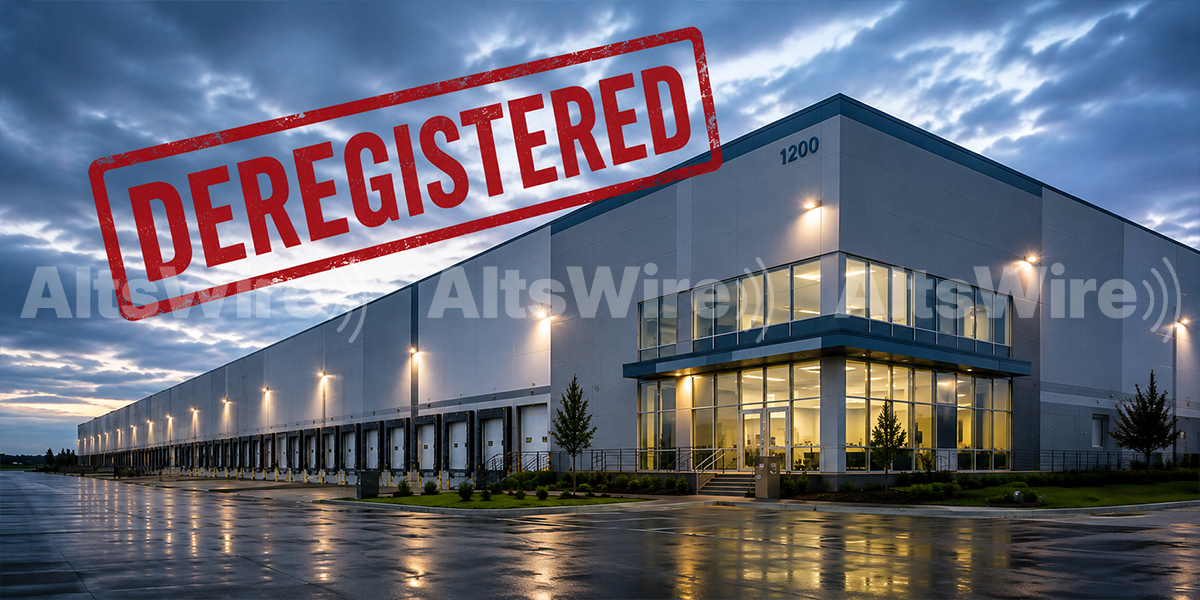
BGO Industrial Real Estate Income Trust Inc. filed to terminate its registration with the U.S. Securities and Exchange Commission, completing the wind-down of a nontraded industrial real estate investment trust program that launched at one of the worst possible moments for the sector — and never sold a meaningful share to an outside investor.
The company filed a Form 15 certifying termination of its registration under the Exchange Act’s Section 12(g), citing a single holder of record as of the filing date. With that, BGO IREIT’s obligations to file annual reports, quarterly reports, and other periodic disclosures with the SEC are extinguished.
The program’s demise traces to a confluence of forces that proved insurmountable for a new entrant to the retail alternatives channel. BGO IREIT launched in July 2023 — at the exact moment the nontraded REIT sector was experiencing its sharpest fundraising collapse in years. Sector-wide capital raises, which had peaked near $34 billion in 2021 and remained above $33 billion in 2022, plunged to approximately $10 billion in 2023 as rising interest rates weighed on real estate values and investors moved aggressively to redeem shares.
Blackstone Real Estate Income Trust and Starwood Real Estate Income Trust, the two largest programs in the space, both capped redemptions in late 2022 — an industry first — and remained gated through much of 2023. The redemption crisis spooked financial advisers and the broker-dealers who distribute nontraded products, effectively freezing the channel for new programs trying to establish themselves.
As AltsWire reported at launch, BGO entered the nontraded space with a $5 billion offering targeting industrial warehouse and logistics properties, distributed exclusively through financial advisers. The program was sponsored by BentallGreenOak, the global institutional real estate investment manager owned by Sun Life Financial, with approximately $90 billion in assets under management. BGO seeded the vehicle with a substantial institutional portfolio — a 56.5% interest in a joint venture holding 9.4 million square feet of Midwestern industrial properties. The properties were developed between 2012 and 2023 by NorthPoint Development and Northwestern Mutual, contributed by Sun Life in exchange for 13 million operating partnership units valued at $130 million.
The institutional credentials were real. The market timing was not. The nontraded REIT distribution channel had effectively closed to new entrants by the time BGO IREIT was ready to raise capital. Advisers and broker-dealers were contending with redemption queues, client anxiety about real estate valuations, and a competitive environment in which private credit and other non-real estate alts were drawing an increasing share of investor allocations. Sector-wide, fundraising remained suppressed well into 2025 — a reported $7.5 billion raised over the trailing 12 months as of mid-2025, with redemptions still exceeding new capital in the first quarter of that year.
BGO IREIT never sold shares to outside investors beyond a nominal 476-share position per class — Class T, S, D, and I — purchased in February 2024 by an affiliate of the adviser for $5,000 per class, or $20,000 in total. The REIT qualification requirements were satisfied separately in January 2024 through a private placement of 125 shares of 12% Series A cumulative non-voting preferred stock at $1,000 per share, raising $125,000 from investors brought in to meet the 100-stockholder threshold required for REIT status under the Internal Revenue Code. The public offering was formally deregistered in August 2025. By March 2026, the last date reflected in the company’s annual report, there were 517 affiliate-held shares outstanding across Class T, S, D, and I — all acquired through distribution reinvestment on the original affiliate purchase.
In a further signal that the retail distribution effort had been abandoned, the REIT named Clint Hinds as chief executive officer of the company in late 2024. Hinds had been a managing director on the BGO portfolio management team since 2019, with a background focused on institutional client relationships and closed-end fund strategy — a profile better suited to managing the underlying assets for existing institutional partners than to building out a retail distribution channel.
Hinds’ appointment coincided with the resignation of Michael Glimcher from his position as CEO and president of BGO IREIT. Glimcher delivered his notice of resignation to the board in November 2024 and continued to serve as a member of the board.
The REIT’s underlying investment — an indirect 34.2% stake in the NorthPoint joint venture — continued to operate throughout. The portfolio carried a book value of approximately $196 million as of mid-2025, and the company declared monthly distributions of $0.0392 per share through at least March 2026, paid to its affiliate shareholders. Net asset value per share for the retail classes stood at $9.84 as of July 2025, below the $10 per share launch price, reflecting the broader pressure on industrial valuations during the period.
Glimcher, a BGO managing director who spoke with AltsWire in a June 2025 feature on industrial real estate trends, remained publicly optimistic about industrial fundamentals, citing e-commerce demand and supply chain resilience as durable drivers.
The broader BGO platform, with its institutional client base and $89 billion in assets under management, was never dependent on the retail channel. BGO IREIT was an attempt to bring that institutional platform to wealth advisers and their clients — a strategy that made considerable sense in 2021 or 2022 when capital was flowing freely into the sector, and very little in 2023 when it was not. The Form 15 filed today closes the chapter.
Visit the AltsWire directory page.