
Why You Should Be Proud to Be an American
By Damon Elder
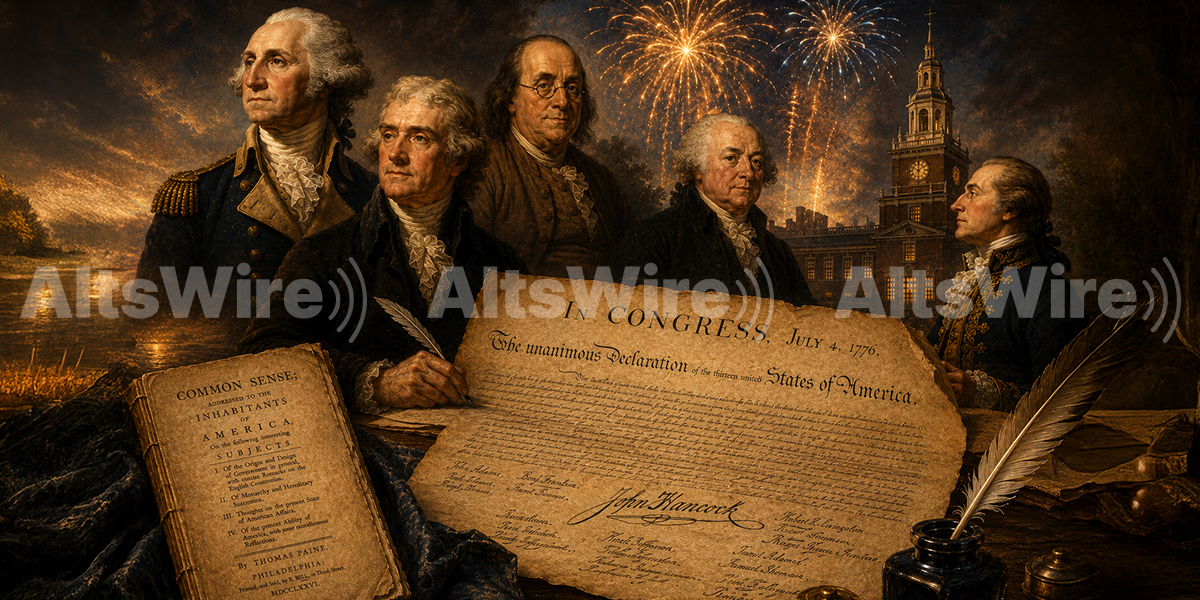
This Fourth of July marks 250 years since a group of colonists signed a document renouncing a king. The anniversary deserves more than acknowledgment. It deserves pride – not the reflexive kind, but the kind earned by understanding exactly what the founders proposed, how rare it was, and how few nations that have attempted the same thing ever made it this far intact.
An Argument, Not a Bloodline
For most of recorded political history, legitimacy ran downhill. A ruler’s claim to power came from inheritance, conquest or divine sanction, and subjects had no formal say in the matter. Tyranny was the default arrangement across empires, kingdoms and city-states for thousands of years, with only scattered exceptions – Rome’s republic, Venice’s oligarchy, the Dutch Republic – none of which extended the principle to the individual as a matter of natural right.
The Declaration of Independence inverted that logic. It held that rights exist prior to government, that people hold them by virtue of being people, and that governments are created to secure those rights rather than to dispense them. Power flows up from the governed, not down from the throne, and consent can be withdrawn when government fails its purpose. Enlightenment philosophers – Locke and Montesquieu among them – had made this argument in theory for decades. America’s distinction was building a nation on it, at scale, and keeping that nation thriving for a quarter of a millennium, guided by those noble founding principles.
A Nation of Laws, Not Men
John Adams wrote the phrase into the Massachusetts Constitution in 1780: a government of laws, and not of men. It became the organizing idea behind the American experiment – that power would answer to written rules rather than to whoever happened to be holding it. The Constitution’s separation of powers and checks between branches were an engineering answer to a question nobody in 1787 could prove: whether a republic could govern a large, diverse territory without collapsing into faction or drifting toward a single strongman.
George Washington supplied the proof, and he supplied it more than once. In 1782, an army officer named Lewis Nicola wrote to suggest that Washington take the title of king; Washington’s reply was immediate and unambiguous, calling the idea abhorrent and warning Nicola to entertain no thought of the kind. The following year, with the war won and Congress unable to pay its army, a group of officers at Newburgh moved toward open confrontation with civilian authority. Washington intervened in person, and the gesture that turned the room – pausing to put on reading glasses his officers had rarely seen him wear, and remarking that he had grown gray, and now nearly blind, in his country’s service – ended the threat without a shot fired. Weeks later, he resigned his military commission to Congress at Annapolis and went home to his farm, by choice, at the height of his power. King George III, on hearing that Washington intended to give up command rather than keep it, is said to have remarked that if he did, he would be the greatest man in the world. He did, and thirteen years later he did it again, declining a third presidential term and returning to private life a second time. Three separate occasions, three separate refusals – the pattern was not an accident of temperament. It was a demonstration, repeated until it could not be mistaken for a fluke, that the executive power of the United States was limited and bound by law, not a throne with a different name.
Where That Path Usually Leads
Most revolutions fought in the name of liberty do not end where they started. The French Revolution invoked the same Enlightenment language as the American one and collapsed within a decade into the Terror, then into Napoleon’s empire. The Russian Revolution promised self-rule for workers and produced, within a generation, one of the most repressive states in history. Twentieth-century decolonization movements across Africa, Asia and Latin America won independence on the strength of self-determination arguments and then, in case after case, settled into one-party rule or military government.
That is the historical pattern: revolutionary idealism curdles once the old regime is gone and something has to fill the vacuum it leaves. The American revolutionaries filled that vacuum with a written Constitution, an independent judiciary and a peaceful transfer of power – and then did it again, every four years, for 250 years, through a civil war, two world wars, a depression and recurring internal conflict. Succeeding down that path, where so many others have failed and fallen into violence or tyranny, is not the ordinary outcome of a revolution. It is the exception, and it is the part of the American story most worth sitting with on this particular anniversary.
A Beacon, Not Just an Example
The Revolution’s most consequential export was not military doctrine. It was proof of concept, and the world noticed. The French Revolution drew on it directly, if far more violently. Bolívar and San Martín modeled Latin America’s break from Spain and Portugal on it explicitly. Independence and constitutional movements from Ireland to India to Vietnam carried its language of natural rights and self-determination into the 19th and 20th centuries. Phrases from the founding era – “all men are created equal,” and Lincoln’s later formulation, “government of the people, by the people, for the people” – still surface in liberation movements far removed from their origin.
John Winthrop described the Puritan colony as a “city upon a hill” in 1630, a century and a half before independence, and the phrase outlived the sermon. It survives because it captures something the founding generation and every generation since has understood about the country’s role: not that America is beyond criticism, but that it has functioned, imperfectly and at real cost, as a working example that self-government by law is possible – and as a place people fleeing tyranny elsewhere have continued to look toward. Most of the vocabulary the world still uses to argue about political legitimacy traces back to that example.
What American Exceptionalism Actually Means
The term gets used loosely, often as a synonym for national vanity. Properly understood, it describes something narrower and more defensible: America’s founding proposition, and its 250-year record of surviving on that proposition rather than abandoning it, is a genuine outlier in the historical record, not a matter of national self-regard. Most nations built on revolutionary ideals about liberty did not keep them. This one, so far, has – not perfectly, and not without argument, but as a matter of continuous record rather than founding myth.
That is also why the country’s expansions of liberty – the ones that took a civil war, a century of civil rights struggle, and ongoing argument to secure – are evidence for the proposition rather than against it. A nation built on a pedigree has no internal argument to make when it falls short of its own claims, because it never made a claim beyond blood and conquest in the first place. A nation built on a proposition can be held to it, and has been, by every generation that thought the country was falling short of its own founding words.
Worth Celebrating, Not Just Marking
America was the first modern nation built on a premise rather than a pedigree: not “we rule because of who we are,” but “we govern ourselves because we are people, and here is the argument for why that is sufficient.” That premise has been tested continuously for 250 years, in circumstances that broke other nations built on similar words, and it has held.
That is the case for treating this Fourth of July as a celebration and not simply an acknowledgment – a celebration of the proposition as much as of the country built on it. A nation of laws, not men. Liberty as a natural right rather than a grant from whoever holds power. Two hundred fifty years of a working example for anyone elsewhere still arguing that free self-government is possible. That is not a small thing to have built, and it is not a small thing to have kept. It is worth being profoundly proud of.
Damon Elder is the publisher and editor-in-chief of AltsWire, as well as president of Spotlight Marketing Communications. He has worked in the alternative investments industry for nearly 20 years and was previously a congressional aide and political consultant before finding honest work in the private sector. Agree or disagree with what you read here? Share your views with him at [email protected]. Thoughtful replies may be published in AltsWire.