
QOF Funds Raise $436.8M in Q3 as Opportunity Zone ‘Dead Period’ Nears

Investment in qualified opportunity zone funds, or QOFs, added an additional $436.8 million in equity during the third quarter of 2025, marking a significant decline from the previous quarter’s $1.14 billion. The slowdown signals investor caution ahead of the anticipated “dead period” for opportunity zone investment before the launch of OZ 2.0 on Jan. 1, 2027.
According to data from Novogradac – a certified public accounting, valuation, and consulting firm specializing in federal tax incentives, the third quarter increase brought total new equity raised in 2025 to $2.39 billion, compared with $1.92 billion during the first three quarters of 2024. Nearly half of 2025’s total was reported in the second quarter, highlighting the uneven pace of fundraising heading into the end of the year.
Novogradac tracks 2,142 qualified opportunity funds, of which 1,709 report specific equity totals, representing $42.48 billion raised through Sept. 30, 2025. The firm’s dataset excludes proprietary or privately held funds, suggesting that total opportunity zone investment may be two to three times greater than the reported amount.
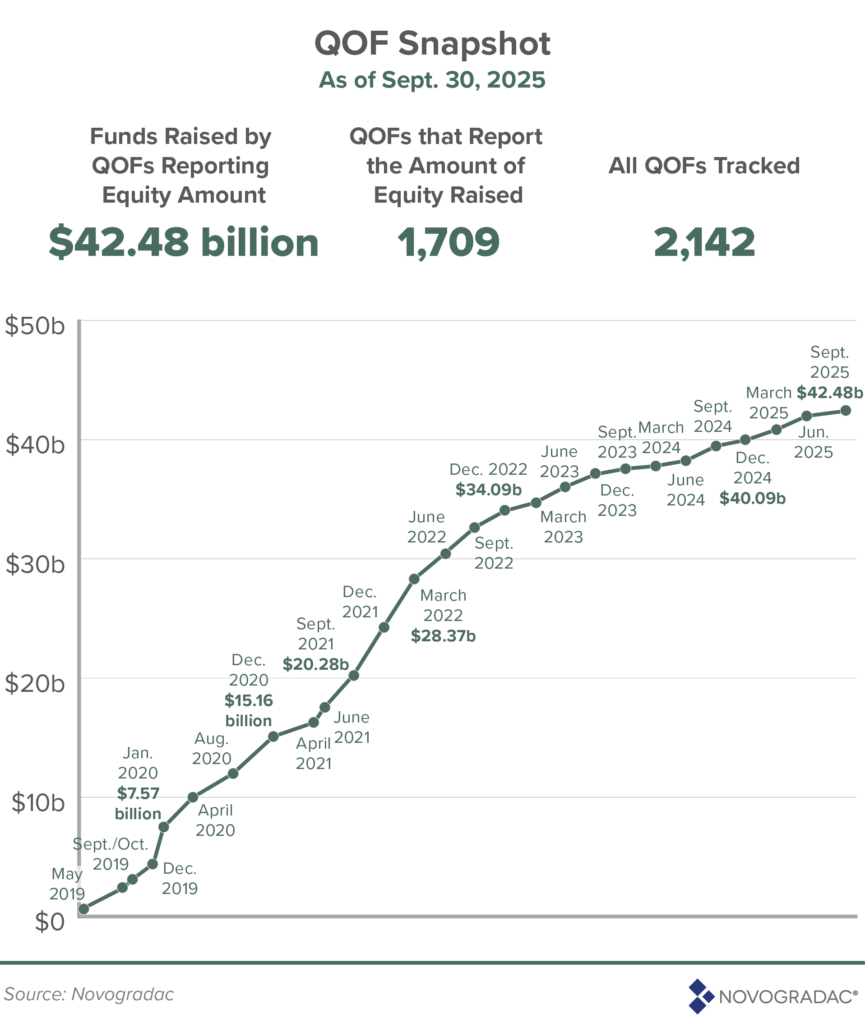
The third quarter began just days before the president signed reconciliation legislation that permanently codified opportunity zones into federal tax law, effective Jan. 1, 2027. Despite this milestone, the quarter’s fundraising total ranked as the fourth lowest since Novogradac began tracking QOF data in 2019.
As a permanent part of the tax code, opportunity zone investments made after 2026 will be eligible for a five-year tax deferral and a 10% basis step-up, increasing to 30% for investments in qualified rural opportunity zone funds. These enhanced incentives are expected to drive a surge in QOF activity once OZ 2.0 launches.
The interim period of 2026 – when current benefits phase down but the new incentives are not yet active – is widely expected to be a “dead year” for opportunity zone investment.
Residential development continues to dominate QOF activity. The 535 funds focused exclusively on residential projects reported $9.03 billion in equity raised, while those with partial residential exposure have collectively raised $33.78 billion.
Commercial-only QOFs have raised $2.59 billion across 285 funds, while all funds with a commercial component total $27.87 billion in combined investment.
Since the program’s inception in 2018, Novogradac has tracked 205,450 homes financed across 241 cities through QOFs. Phoenix, Nashville, and Washington, D.C. each report more than 7,000 homes funded.
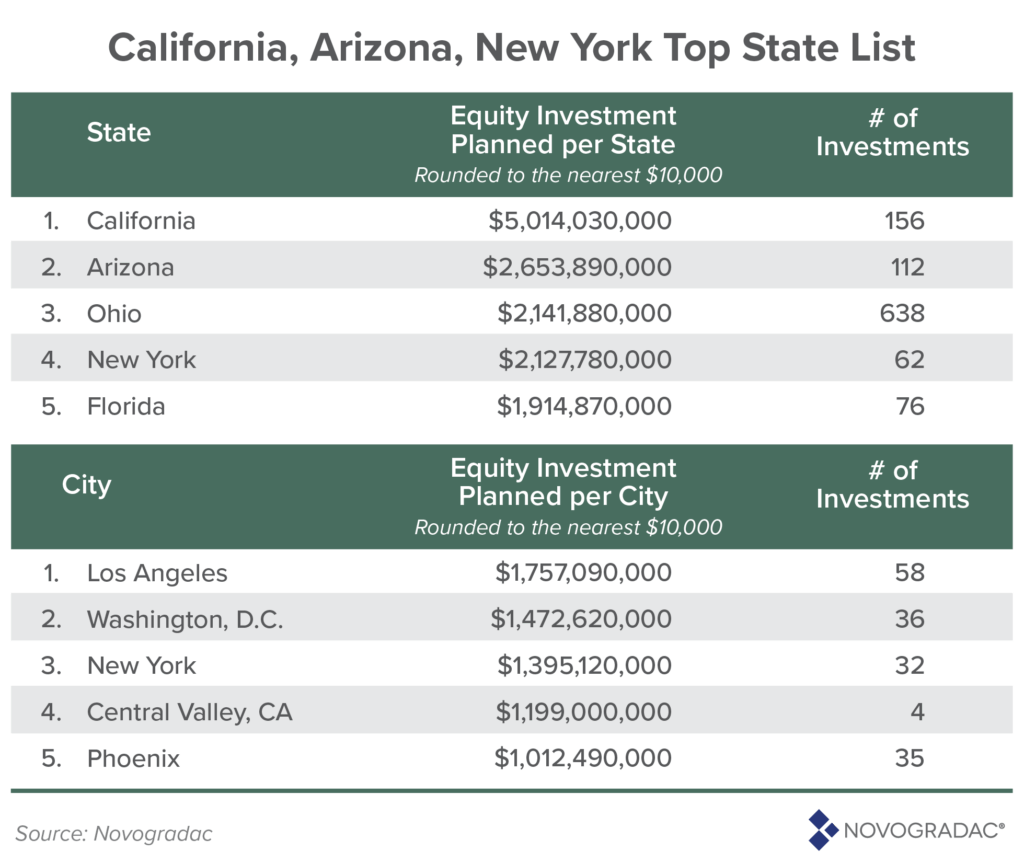
At the state level, California remains the clear leader, surpassing $5 billion in planned QOF investment by the end of Q3 2025, with 156 individual projects. Arizona, Ohio, New York, and Florida round out the top five states, while the leading metro regions include Los Angeles, Washington, D.C., New York, Central California, and Phoenix.
As previously reported by AltsWire, several changes from the reconciliation bill took effect immediately –most notably a reduction in the substantial improvement requirement for rural OZ projects, from 100% to 50% of the property’s original basis. The adjustment is designed to accelerate capital deployment in rural and underserved markets ahead of the 2027 relaunch.
Click here to visit the AltsWire directory page.