Nontraded BDC Fundraising Falls to Lowest Quarterly Level Since 2020
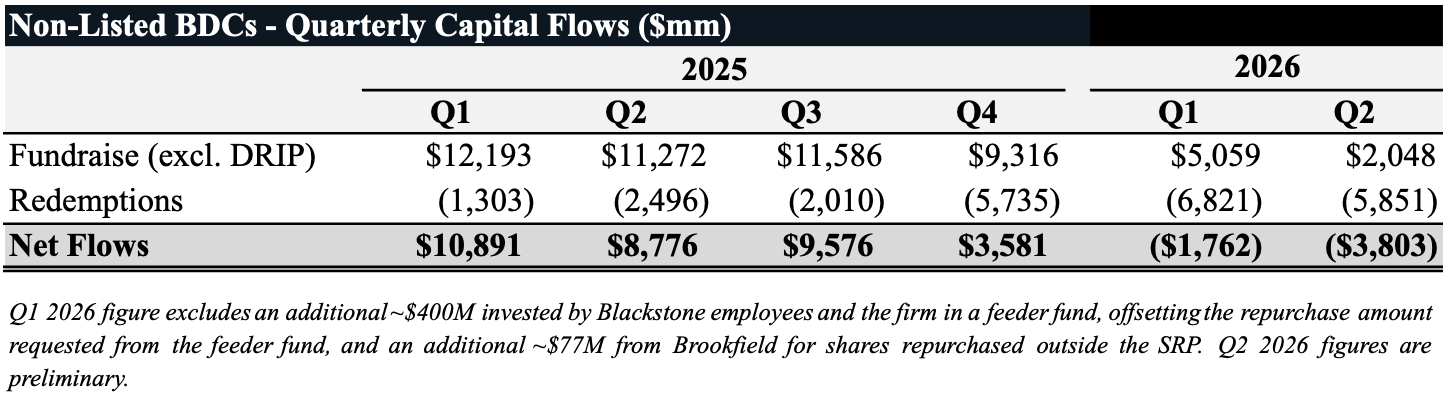
Nontraded business development companies registered with the U.S. Securities and Exchange Commission raised $2 billion in the second quarter of 2026, a decline of 82% from the same period in 2025. That marks the weakest quarterly total since the fourth quarter of 2020 – before Blackstone Private Credit Fund, or BCRED, and Blue Owl Credit Income Corp., or OCIC, entered the fundraising market. Capital raised across the first half of 2026 totaled $7.1 billion, down 70% from the $23.5 billion raised over the same period in 2025, according to investment banking firm Robert A. Stanger & Co. Inc.
Meanwhile, redemption demand climbed to its highest level yet in the second quarter, though sponsors have continued to meet that demand without imposing redemption gates. Repurchase requests came in at 12.4% of NAV for the quarter, up from 10.4% in Q1 2026 and the highest level Stanger has recorded. Sponsors fulfilled 38% of those requests, returning $5.9 billion to investors during the quarter and $12.7 billion for the year to date through June 30.
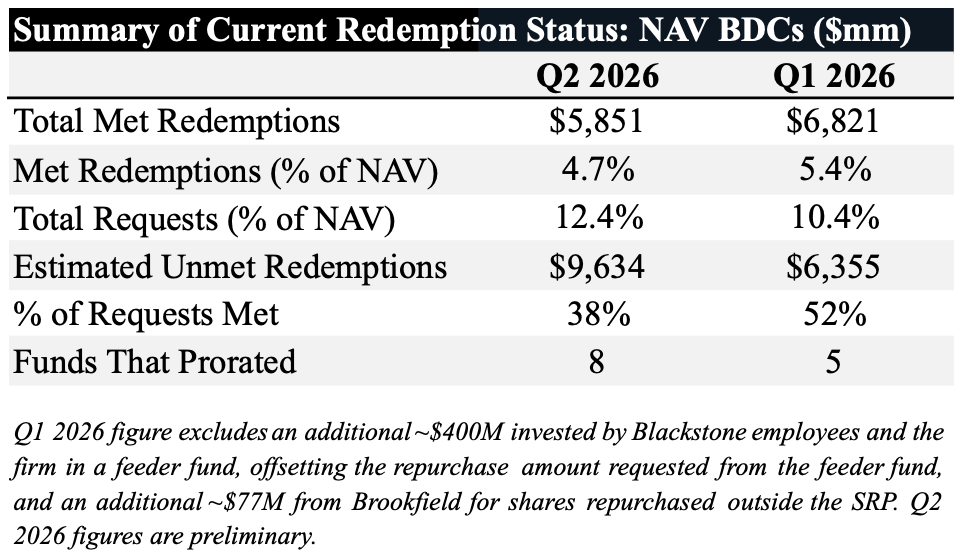
Redemptions exceeded new capital by nearly three times during Q2 2026, producing net outflows of approximately $3.8 billion and marking the sector’s second consecutive quarter of net outflows. For the first half, redemptions exceeded fundraising by approximately $5.6 billion. That pressure was also reflected in market size, with aggregate NAV for publicly registered NAV BDCs declining 3.1% quarter-over-quarter to approximately $122.4 billion, while remaining 7.3% above June 2025 levels.
“The Stanger Liquidity Cycle has moved out of its early stage and into its most demanding one,” said Kevin T. Gannon, chairman and chief executive officer of Stanger. “Fundraising has contracted sharply, redemption demand remains elevated, and the pressure is now visible in net flows and market size. At the same time, sponsors continue to deliver substantial liquidity within defined program limits, with proration functioning as designed to balance liquidity demand against protection of the investors who remain.”
Early Q3 2026 reporting offers a preliminary sign of moderation, but the sample remains limited. Three NAV BDCs have reported to date, with repurchase requests equal to 4.6% of NAV versus 7.9% for those same funds in Q2. Two met 100% of requests and the third received none, though the sample remains too small to yet indicate a broader market trend.
“Early Q3 data offers an encouraging initial read, but it is too limited to determine whether redemption pressure is easing across the broader market,” Gannon said.
Investment performance may be driving redemption activity. For the second quarter, the Stanger NL BDC Total Return Index gained only 1.2% after a flat first quarter, while the current distribution rate of the overall space is over 9% annualized. This downdraft in total return is manifesting itself in redemption activity from investors.
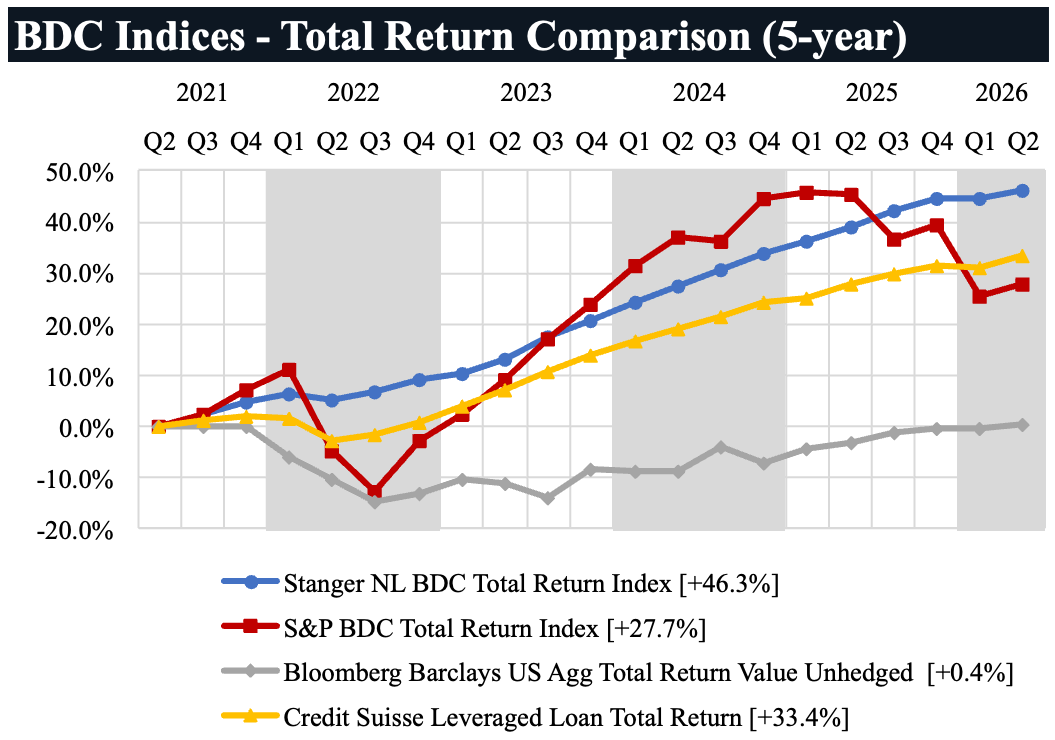
“The market is demonstrating an intelligent response to flattening investment performance,” Gannon added. “The months ahead will provide an important test of valuation discipline across the sector as sponsors manage portfolios to fund continued liquidity demand.”
Performance leaders across key time periods are shown.
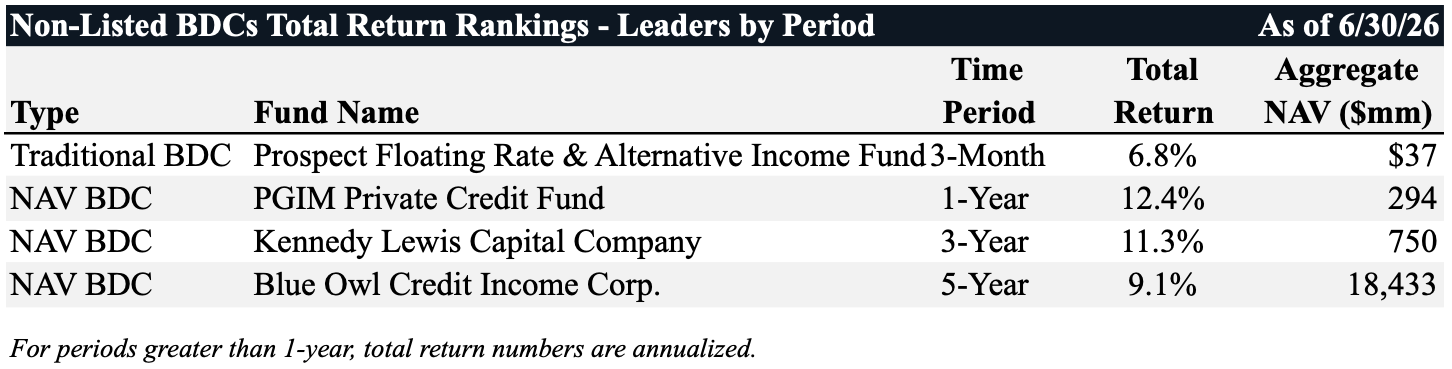
Despite OCIC receiving repurchase requests for 18.8% of shares outstanding as of March 31 – $3.6 billion – prorating and satisfying approximately 27% of each shareholder’s request, the NAV BDC tops the five-year total return rankings with 9.1% as of the end of June.
The Stanger NL BDC Total Return Index measures the performance of nontraded BDCs on a quarterly basis. Stanger began calculating the index on Dec. 31, 2015, with a base of 100. Perpetually offered, nontraded BDCs that update their NAVs no less frequently than monthly and that have a minimum of one calendar quarter of performance are included in the index. As of Q2 2026, the index includes 25 BDCs with a total of 58 separate share classes.
Founded in 1978, Robert A. Stanger & Company is an investment banking firm providing advisory, valuation, and capital markets services to real estate investment trusts, partnerships, and related entities.
Visit the AltsWire directory page.