
George Washington: The Indispensable American
By Damon Elder
In the long arc of history, nations are rarely shaped by a single individual. Yet there are moments when the character of one person alters the trajectory not only of a country, but of the world. For the United States, that person was George Washington.
To call Washington “the Father of His Country” risks reducing him to marble and myth. He was not a demigod, nor was he without flaws. He was a man of his time – ambitious, proud, occasionally rigid, and a lifelong slaveholder who struggled, imperfectly and late, with the moral contradictions of that institution. But history turns not on perfection. It turns on decisions. And at several decisive moments in the American founding, Washington chose restraint over ambition, republican virtue over personal power, and national unity over faction. Without those choices, the United States – and the global expansion of constitutional liberty that followed – might not have endured.
Washington’s indispensability began on the battlefield. When the Second Continental Congress appointed him commander in chief in 1775, the American cause was fragile and fractious. The colonies were divided by region, economy, and culture. The Continental Army was undertrained, undersupplied, and often unpaid. Washington’s early campaigns were marked by setbacks – most notably the loss of New York in 1776. Yet it was precisely his steadiness in defeat that proved decisive.
His daring crossing of the Delaware River and the surprise victories at Trenton and Princeton were more than tactical successes; they revived a revolution on the brink of collapse. Washington understood that survival, not spectacular triumph, was the key to defeating the world’s most powerful empire. By keeping the army intact through the brutal winter at Valley Forge and by refusing to gamble recklessly for glory, he transformed a rebellion into a sustained war for independence.
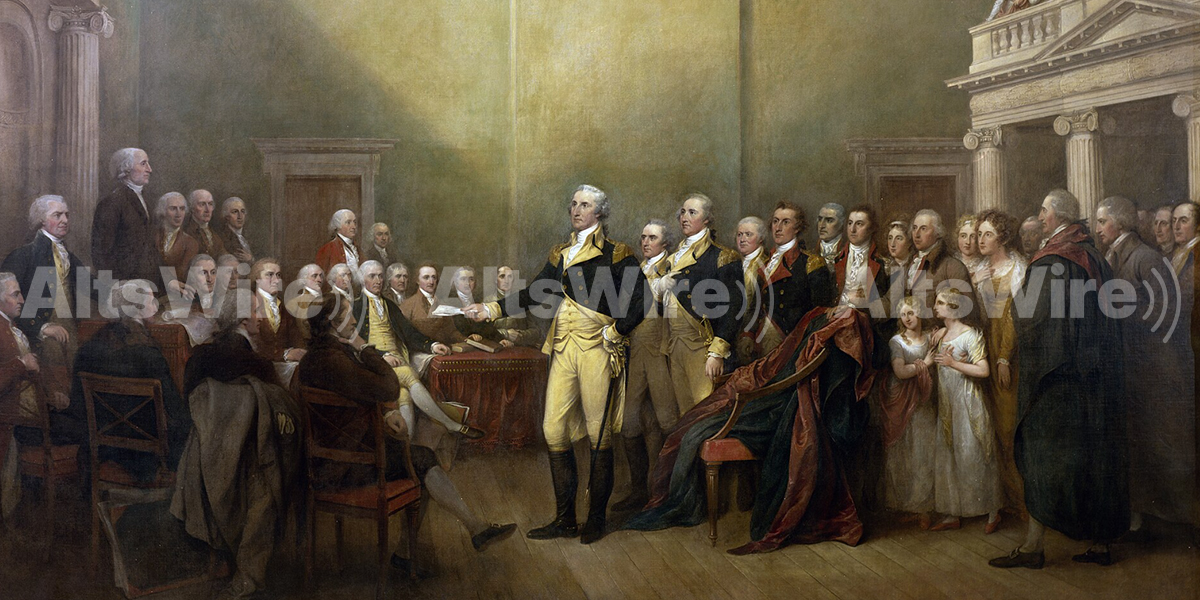
But Washington’s greatest act during the Revolution was not military – it was political. In 1783, after eight years of war, with his army still loyal to him and some officers whispering about seizing power over a weak Congress, Washington did something almost unprecedented in history. He resigned his commission and returned to private life.
At a time when victorious generals often crowned themselves rulers, Washington surrendered power to civilian authority. King George III reportedly remarked that if Washington truly relinquished command and retired, he would be “the greatest man in the world.” By submitting the military to Congress, Washington cemented the principle of civilian control and demonstrated that the Revolution had been fought not to replace one strongman with another, but to establish republican government.
The fragile peace that followed revealed how close the new nation was to failure. Under the Articles of Confederation, the United States was disunited and economically unstable. Once again, Washington’s presence proved essential. Though he had hoped to remain at Mount Vernon, his support for the Constitutional Convention in 1787 lent it legitimacy. His decision to preside over the convention reassured wary states that the effort was not a coup, but a constructive reform.
When the Constitution was ratified, there was little doubt who must serve as the first president. Washington did not seek the office eagerly. He was 57 years old, weary of public life, and conscious of the burdens ahead. But he understood that the new republic required a unifying figure — someone trusted across regions and factions — to give the presidency dignity and stability. He accepted not out of ambition, but out of duty.
As president, Washington set precedents that still define the office. He established the practice of forming a cabinet, balancing strong personalities such as Alexander Hamilton and Thomas Jefferson. He asserted federal authority when necessary, most notably in suppressing the Whiskey Rebellion, demonstrating that the new government had both the power and the will to enforce its laws. Yet he exercised that power carefully, mindful that excessive force could endanger liberty.
In foreign affairs, Washington navigated between Britain and revolutionary France, resisting pressure to entangle the young nation in European wars. His Proclamation of Neutrality in 1793 laid the groundwork for an independent American foreign policy – guided by national interest rather than ideological fervor.
Perhaps most importantly, Washington defined the presidency by what he refused to do. After two terms, with no constitutional requirement to step down, he voluntarily relinquished office. In doing so, he established the two-term precedent that endured for more than 140 years. Again, he chose republican restraint over personal power.
Washington’s Farewell Address warned against the dangers of factionalism and sectional division. His caution that political parties could inflame passions and weaken national unity reads as prescient today. While parties would become a permanent feature of American politics, his warning underscored his lifelong commitment to national cohesion above partisan gain.
None of this erases Washington’s imperfections. He owned enslaved people throughout his life, benefiting from an institution fundamentally at odds with the liberty he championed. Yet even here, his legacy is complex. In his will, he arranged for the emancipation of the enslaved people he directly owned — a rare and consequential act among Virginia’s founding generation. Importantly, he did not simply release them into uncertainty. He directed that the elderly and infirm be supported financially for the remainder of their lives and that younger freed individuals be educated or trained in trades so they could support themselves. This was an extraordinary provision in the context of the time. It did not resolve the nation’s foundational contradiction, but it reflected a man increasingly aware of the moral gravity of the issue and willing, at the end of his life, to act within his power to mitigate it.
The broader truth remains: Washington’s consistent choice to subordinate himself to constitutional order made liberal government possible. In the classical sense – grounded in limited government, individual rights, rule of law, and consent of the governed – American constitutionalism became a model emulated around the world. The spread of representative institutions across Europe and the Americas in the 19th century drew strength from the example of a republic that had survived its infancy.
Had Washington seized power in 1783, the American experiment might have devolved into dictatorship. Had he clung to the presidency, it might have hardened into something less than a republic. Instead, he demonstrated that power could be exercised firmly yet surrendered freely.
In that sense, Washington was, and remains, the essential American – not because he was flawless, but because he understood that liberty requires self-restraint. His greatness lay not merely in victory, but in renunciation; not merely in authority, but in his willingness to relinquish it. At each critical juncture, he chose the harder right over the easier path of ambition.
His life established the habits of republican governance at a moment when those habits were far from assured. The institutions he helped stabilize became the framework within which personal liberty expanded, first in the United States and eventually across much of the world.
History rarely grants second chances to fragile republics. The United States received one in the character of George Washington – a man who was, and is, the indispensable American.
Damon Elder is the publisher and editor-in-chief of AltsWire, as well as president of Spotlight Marketing Communications. He has worked in the alternative investments industry for nearly 20 years and was previously a congressional aide and political consultant before finding honest work in the private sector. Agree or disagree with what you read here? Share your views with him at damon@altswire.com. Thoughtful replies may be published in AltsWire.