
Five Questions for Secure Real Estate Exchange President Brian Mansouri
By Staff
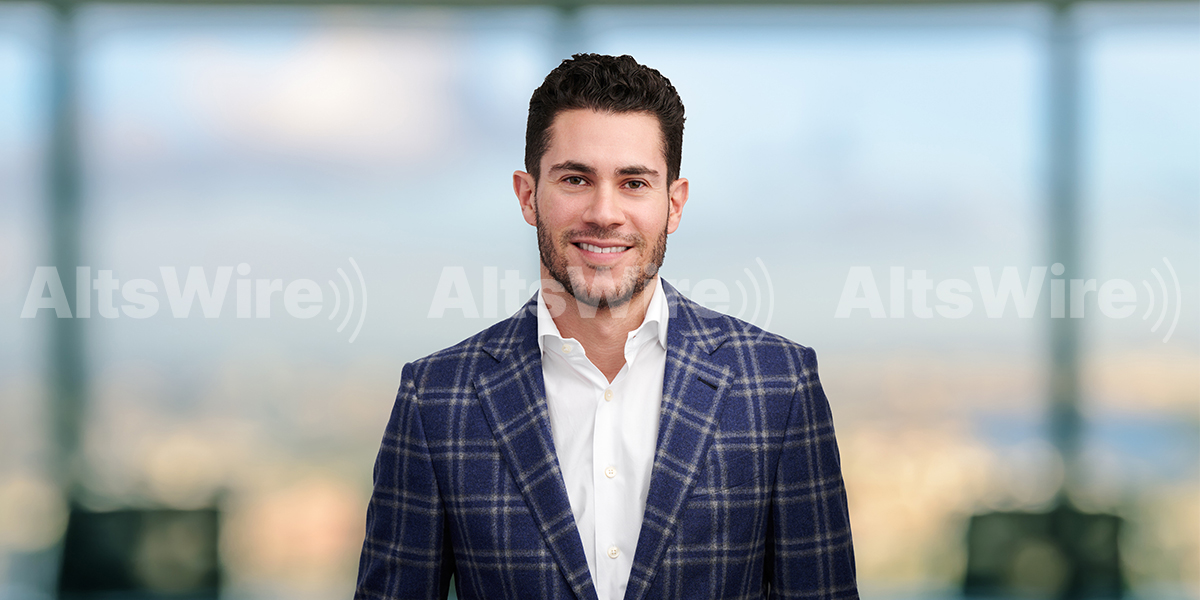
For the latest installment of “Five Questions for…,” the AltsWire editorial team sat down with Brian Mansouri, managing principal at Secure Properties and president of Secure Real Estate Exchange. Throughout his career, Mansouri has originated, underwritten, and closed more than $4 billion of net-lease real estate transactions across a wide range of asset types and market cycles. He brings deep experience working with institutional and private capital partners and structuring transactions to align long-term investment objectives.
AltsWire: How are today’s macroeconomic conditions influencing the alternatives market?
Brian Mansouri: The past several years have fundamentally reshaped how investors think about portfolio construction. Persistent inflation, elevated interest rates, and rising geopolitical uncertainty have exposed vulnerabilities in traditional stock-and-bond portfolios, and investors have responded by looking more seriously at real assets capable of delivering durable income and meaningful diversification.
What’s notable right now is that the stress isn’t limited to public markets. Across the private credit industry, a wave of redemption requests has left billions of investor capital trapped behind withdrawal limits. The underlying issue is a structural mismatch: investors are offered quarterly redemption windows, but the underlying assets simply cannot be liquidated on that timetable.
This dynamic resonates in the Delaware statutory trust space as well, though for different reasons. DST investors aren’t navigating redemption gates, but they face their own form of illiquidity; once capital is deployed into a DST, it’s typically locked until the sponsor executes an exit. The discipline applied at acquisition is what creates the conditions for a successful outcome, not just a successful hold.
As a result, we’re seeing the alternatives market continue to mature and institutionalize. Investors are asking harder questions, demanding greater transparency, and placing a premium on sponsors with real underwriting discipline and sector expertise. The bar has been raised, and that’s a healthy development for the market generally.
AW: What are investors currently prioritizing when allocating to real estate alternatives?
BM: After a period where value-add and opportunistic strategies dominated, investors are gravitating back toward predictability. The appetite for complexity has declined; the appetite for quality has not.
We’re seeing strong demand for long-term net lease assets, particularly those with contractual annual rent increases. These structures provide a highly transparent income stream that is not dependent on business plan execution or a favorable exit environment, while also offering built-in growth that helps offset inflation over time. Net lease real estate is a strong example. The operating business bears most of the property-level costs, which simplifies the income picture for investors considerably.
Perhaps most importantly, advisers are placing far greater emphasis on sponsor track record within a specific asset class. Generalist strategies are facing more scrutiny. It appears that investors want to see that a sponsor has done this before and aren’t straying from what they know best.
AW: How do you see the Delaware statutory trust market evolving?
BM: The DST market is at an interesting inflection point. Historically, some offerings were structured primarily to capture 1031 exchange demand, but real estate was secondary to the tax solution. We believe the market is moving in a healthier direction, one where high-quality real estate comes first and the DST structure is simply the vehicle through which investors participate.
Distribution platforms and advisers are raising the bar around underwriting rigor, reporting quality, and sponsor expertise. More sponsors are entering the space with deep asset-class-specific experience, which is raising the overall quality of what’s available. Investors are increasingly thinking about DSTs – not just as a transactional tool for deferring again – but as a component of longer-term real estate portfolio construction.
Our perspective has always been that investment should drive the structure, not the other way around, and we’re now seeing the market move decisively in that direction.
AW: What differentiates successful alternative investment sponsors today, and what role should alternatives play in a long-term investment portfolio?
BM: The sponsors gaining traction today share a few defining characteristics. First is investment discipline over product distribution. The best operators have a clear thesis, genuine expertise in a specific asset class, and a consistent underwriting process.
Capital structure conservatism has proven equally important. Sponsors who leaned on aggressive leverage during the low-rate environment are now impacted. Rates have moved more than 300 basis points, and buyers and lenders are underwriting assets significantly wider. Both refinancing and disposition have become harder.
Finally, transparency is key. In a market where many investors are coming to alternatives for the first time, clear and consistent communication about performance, capital structure, and risk is helping sponsors build trust.
Alts can play an important role in long-term portfolio constructions, particularly as a source of durable income and diversification that is difficult to replicate in public markets. For example, real estate offers exposure to cash flow that is less correlated with equity and bond market volatility. Real estate prices don’t reprice overnight the way publicly traded securities do; the asset class rewards patience. These are investments that need to be sized and held accordingly.
For investors in or approaching retirement, that income stability can be particularly valuable. A well-structured allocation to real estate or other income-generating alternatives can help smooth out the volatility that makes public market portfolios difficult to draw from in down years
AW: You recently launched a DST program. What prompted this and what are you hoping to build?
BM: We have spent years deploying and managing capital on behalf of family offices, ultra-high-net-worth investors, and institutional clients. Today, we manage nearly $2 billion in net lease assets and have raised $850 million in equity since inception, including $400 million in 2025 alone. The DST platform isn’t a new strategy for us but rather a way to make that same investment philosophy accessible to a broader set of investors.
Our decision to enter the DST market was deliberate, driven by a clear gap we identified in the net lease space. Many sponsors in the market rely on a steady cadence of DST offerings to support their platforms, which can, at times, create pressure to prioritize volume. As a result, a meaningful portion of capital flowing into net lease DSTs is being deployed by groups whose core expertise is in syndication rather than long-term net lease ownership and asset management.
We approach the business from an ownership mindset. We’re not trying to manufacture product or chase market share; we’re focused on acquiring well-located assets at the right basis and holding them through the cycle. That alignment is critical in net lease, where value creation is less about executing value-add strategies and more about buying well and structuring investments properly from day one.
For 1031 investors, net lease DSTs can be a natural fit, offering tax-efficient, durable income when executed with the right underwriting and asset selection. It’s not a value-add strategy, and we don’t position it that way. The goal is consistency, downside protection, and steady performance over time. We’re already seeing that resonate – our first offering is pacing ahead of expectations in terms of equity raised.
Near term, our focus is on establishing Secure as a selective, trusted sponsor known for transparency and institutional-quality underwriting. Over time, we believe the market will increasingly favor platforms that think like investors rather than distributors, and our objective is to build a track record that reflects that.
Brian Mansouri serves as managing principal of Secure Properties, where he leads the firm’s investment activities and strategic growth initiatives. He focuses on building and managing relationships with capital partners, lenders, and equity investors; expanding the firm’s investment strategies and platforms; sourcing investment opportunities; and working closely with the team to manage the portfolio and navigate asset- and portfolio-level situations. Mansouri also serves as president of Secure Real Estate Exchange, the firm’s dedicated DST platform. Prior to Secure, Mansouri was a partner and head of net lease at SomeraRoad, where he led a net-lease-focused investment portfolio of approximately $1 billion. Before SomeraRoad, he served as senior vice president at AR Global Investments, where he oversaw acquisitions across two publicly traded net-lease real estate investment trusts with more than $7 billion in assets.
Visit the AltsWire directory page.