
Escalent Annual Report Measures Financial Advisers’ Adoption of Alts by AUM

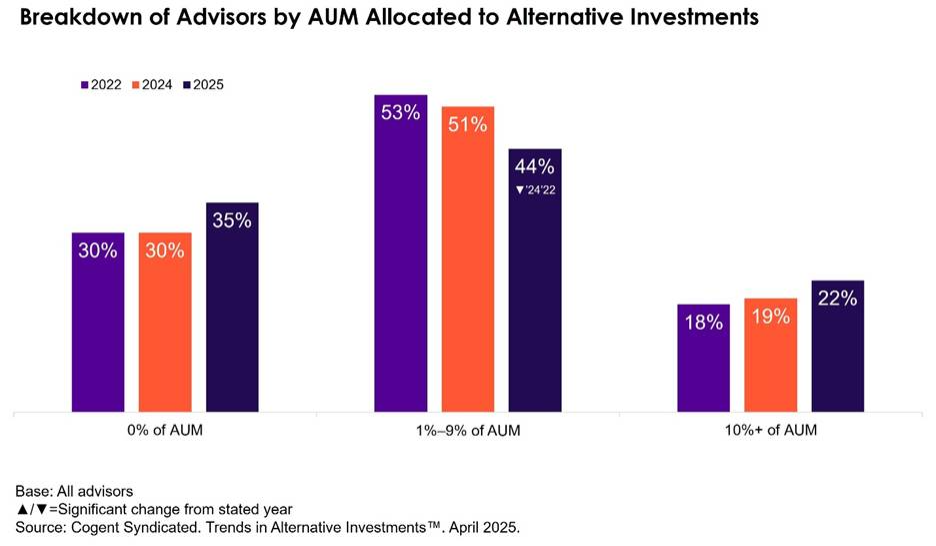
Amid economic volatility and uncertainty, advisers are making noticeable adjustments to their portfolio strategies—particularly in their use of alternative investments. While allocations to alternative investments continue to climb, the percentage of advisers categorized as light users, those with 1% to 9% of assets under management in alts, has notably shrunken as heavy users, those with 10% or more of AUM in alts, deepen their commitments.
This is according to the latest Cogent Syndicated Trends in Alternative Investments report from Escalent, a research, data analytics, and advisory firm. The annual report measures the rate of adoption and share of assets dedicated to alternative investments among advisers and affluent investors as well as which asset classes within the category are currently favored and how they are being accessed.
Cogent Syndicated conducted an online survey from Feb. 10 to Feb. 24, 2025, of a representative sample of 648 financial advisers. In order to qualify for this study, survey participants were required to have a book of business of at least $5 million and offer financial advice or planning services to individual investors on a fee or transaction basis.
This year’s report also leveraged The Advisor Exchange, Escalent’s online insight community of financial advisers, to gather qualitative insights for a deeper dive into advisers’ opinions on private markets and their anticipated growth.
“Advisers with less experience in alternative products are increasingly abandoning the category, having incurred negative outcomes, particularly in private markets. This is evidenced by a 7% decline in ‘light users,’ with a corresponding 5% rise in ‘non-users,’” said Kristin Hall, report author and senior product manager Escalent’s Cogent Syndicated division. “Conversely, more experienced advisers are continuing to increase their allocations to alternatives, with the proportion of those with more than 10% of AUM allocated to alternatives growing from 19% to 22% year over year.”
Likely in response to market volatility, inflation and the pursuit of diversification, 44% of advisers view alternative assets primarily as a hedge for risk mitigation, up significantly over the past 12 months. Looking ahead, more than half anticipate increasing their hedge allocations further over the next two years. In contrast, the percentage of advisers using alternatives for “core” portfolio stability is down significantly, indicating a shift in perceived utility for the category.
Despite liquidity remaining a critical consideration for adoption, advisers are increasing their use of real estate, private equity and private credit as a hedge or risk mitigation tool. Real estate and real estate investment trusts continue to be the most popular alternative asset class with 68% of advisers indicating they use or plan to use the sub-asset. Private equity (48%), structured products (40%), and private credit (35%) also emerged as areas of growing interest, especially favored by heavy users. Alternatively, a surge in digital assets and cryptocurrencies was driven by light allocators.
“As the ‘retailization’ of alternative investments accelerates and the narrative of widespread alternative adoption becomes more prevalent, it’s crucial to recognize that not all advisers and investors are embracing them. There’s a clear divide between those who are strong proponents of the asset class and those avoiding alternatives altogether,” said Linda York, a senior vice president at Cogent Syndicated. “Recognizing that alternatives aren’t a fit for everyone, asset managers and advisers must focus on understanding and engaging their advocates rather than pursuing a broad-based approach.”
In determining the sampling frame for this study, Cogent relied upon the most recent Discovery registered representative and registered investment adviser databases.
To ensure the population for this research was representative of the universe of financial advisers, the databases were analyzed to determine the current distribution of advisers by AUM, channel, age, gender, and region. According to Cogent, quotas were then established to produce a final set of respondents that is truly reflective of the adviser population. Minimal weighting was applied to adjust for any deviations from the actual marketplace distribution. The data have a margin of error of ±3.85% at the 95% confidence level.
Escalent is a research, data analytics, and advisory firm that helps clients understand human and market behaviors to navigate disruption.
Click here to visit the AltsWire directory page.