
Common Sense: Key Passages from Thomas Paine’s 1776 Pamphlet
By Staff
Publisher’s Note
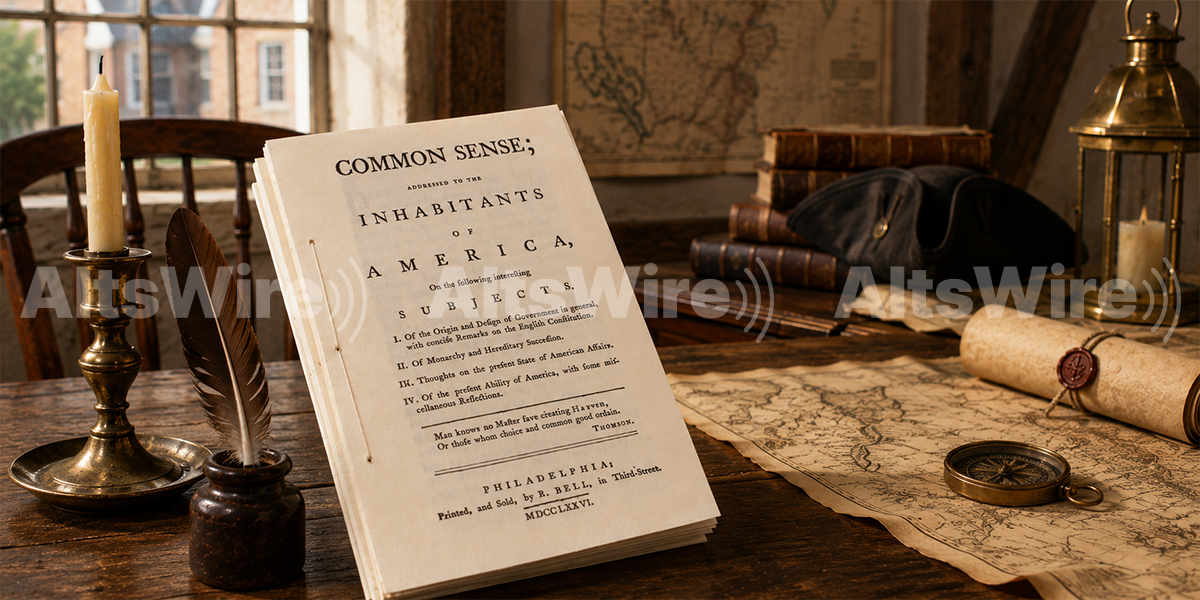
Where the Declaration and the Constitution are compact enough to run in full, Common Sense is not – the pamphlet runs to roughly 20,000 words, a full sitting few readers will give it today, however many gave it one in 1776. Its influence is hard to overstate. Selling in the hundreds of thousands within months in a country of some 2.5 million people, it moved ordinary colonists toward independence in a way the more formal arguments of the era did not. John Adams, who disliked Paine personally, put the pamphlet’s importance plainly: “Without the pen of the author of Common Sense, the sword of Washington would have been raised in vain.”
Rather than reproduce the whole, we’ve selected the passages that carry its central argument – that legitimacy rests on reason rather than bloodline, that hereditary rule is an absurdity dressed up as divine right, and that a government of law rather than of a man was both possible and worth the fight. It is much the same argument the Declaration would make six months later, in plainer language built for the tavern and the town meeting rather than the salon. Ellipses mark omissions; nothing within a passage has been altered. Spelling, capitalization, and punctuation are Paine’s own, reproduced from the Project Gutenberg edition of the original 1776 Bradford text.
– Damon Elder, Publisher & Editor-in-Chief
From the Introduction
Perhaps the sentiments contained in the following pages, are not yet sufficiently fashionable to procure them general favor; a long habit of not thinking a thing wrong, gives it a superficial appearance of being right, and raises at first a formidable outcry in defense of custom. But the tumult soon subsides. Time makes more converts than reason…. The cause of America is in a great measure the cause of all mankind.
On the difference between society and government
Some writers have so confounded society with government, as to leave little or no distinction between them; whereas they are not only different, but have different origins. Society is produced by our wants, and government by our wickedness; the former promotes our happiness positively by uniting our affections, the latter negatively by restraining our vices…. Society in every state is a blessing, but government even in its best state is but a necessary evil…. Wherefore, security being the true design and end of government, it unanswerably follows that whatever form thereof appears most likely to ensure it to us, with the least expence and greatest benefit, is preferable to all others.
On the true source of a government’s strength
And as this frequent interchange will establish a common interest with every part of the community, they will mutually and naturally support each other, and on this (not on the unmeaning name of king) depends the strength of government, and the happiness of the governed…. Here then is the origin and rise of government; namely, a mode rendered necessary by the inability of moral virtue to govern the world; here too is the design and end of government, viz. freedom and security.
On monarchy and hereditary succession
Mankind being originally equals in the order of creation, the equality could only be destroyed by some subsequent circumstance…. But there is another and greater distinction for which no truly natural or religious reason can be assigned, and that is, the distinction of men into kings and subjects. Male and female are the distinctions of nature, good and bad the distinctions of heaven; but how a race of men came into the world so exalted above the rest, and distinguished like some new species, is worth enquiring into, and whether they are the means of happiness or of misery to mankind.
On the folly of hereditary right
To the evil of monarchy we have added that of hereditary succession; and as the first is a degradation and lessening of ourselves, so the second, claimed as a matter of right, is an insult and an imposition on posterity. For all men being originally equals, no one by birth could have a right to set up his own family in perpetual preference to all others for ever, and though himself might deserve some decent degree of honors of his cotemporaries, yet his descendants might be far too unworthy to inherit them. One of the strongest natural proofs of the folly of hereditary right in kings, is, that nature disapproves it, otherwise she would not so frequently turn it into ridicule by giving mankind an ass for a lion.
On the stakes of the moment
The sun never shined on a cause of greater worth. ‘Tis not the affair of a city, a country, a province, or a kingdom, but of a continent—of at least one eighth part of the habitable globe. ‘Tis not the concern of a day, a year, or an age; posterity are virtually involved in the contest, and will be more or less affected, even to the end of time, by the proceedings now. Now is the seed time of continental union, faith and honor.
On America as a refuge
This new world hath been the asylum for the persecuted lovers of civil and religious liberty from every part of Europe. Hither have they fled, not from the tender embraces of the mother, but from the cruelty of the monster…. O ye that love mankind! Ye that dare oppose, not only the tyranny, but the tyrant, stand forth! Every spot of the old world is overrun with oppression. Freedom hath been hunted round the globe. Asia, and Africa, have long expelled her.—Europe regards her like a stranger, and England hath given her warning to depart. O! receive the fugitive, and prepare in time an asylum for mankind.
On law as king
But where says some is the King of America? I’ll tell you Friend, he reigns above, and doth not make havoc of mankind like the Royal Brute of Britain…. let a crown be placed thereon, by which the world may know, that so far as we approve of monarchy, that in America the law is king. For as in absolute governments the King is law, so in free countries the law ought to be King; and there ought to be no other.
On the chance to begin again
We have it in our power to begin the world over again. A situation, similar to the present, hath not happened since the days of Noah until now. The birthday of a new world is at hand, and a race of men, perhaps as numerous as all Europe contains, are to receive their portion of freedom from the event of a few months.
Source: Project Gutenberg edition of Common Sense (Bradford, 1776), by Thomas Paine.